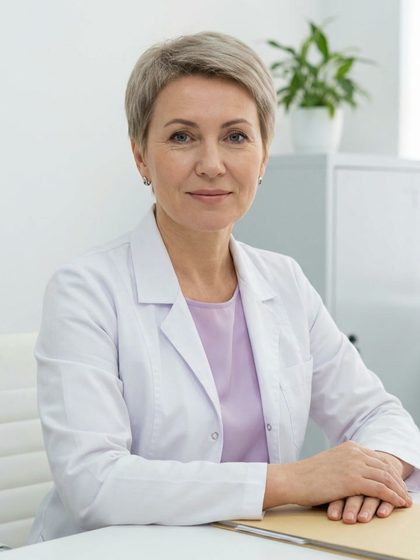
Reviewed byOlga Smirnova, MDAddiction psychiatrist, experience 27 years · updated 8 Nov 2026
Key facts
- ICD-10 code
- F10.2
- Who provides it
- An addiction medicine doctor (narcologist), a psychiatrist and a psychotherapist; a gynecologist and an internist if needed
- Where
- At home, in a private room in the inpatient unit, on an outpatient basis and online
- Duration
- Detox takes 1–5 days; maintenance treatment and psychotherapy last from several months
- Anonymity
- Complete confidentiality, no registry, visits at a time that suits you
- When it’s urgent
- Drinking during pregnancy, seizures, hallucinations, suicidal thoughts — call 103 or 112
- Outcome
- Safe sobriety, treatment of depression and anxiety, and restored health
What you should know
Calls about women are different from the very first minute. Most often it isn’t the husband who calls but the woman herself, in a whisper, during the day while the children are at school. Or an adult daughter who has found bottles behind the washing machine. In these cases, the dispatcher checks whether it is safe to talk and whether we can come while no one else is home. We arrive in Medeu or Bostandyk district without uniforms and without any questions at the entrance to the building, and the first thing I say is that the conversation will stay between us.
In the apartment, I often meet a well-groomed woman who is more ashamed of her condition than she is suffering from the hangover itself. She drinks wine in the evenings, sometimes starts during the day, hides it from her family and blames herself. I measure her blood pressure and ask about sleep, mood, medications and whether she might be pregnant. Quite often, depression or anxiety is hiding beneath the alcohol, and without treating them, sobriety won’t hold. That is why, after the IV drip, we talk not only about alcohol but also about what drives her to drink.
Signs of Alcohol Dependence in Women
- alcohol becomes the main way to relieve anxiety, fatigue or loneliness
- drinking is hidden: bottles are stashed away, wine is drunk alone
- the woman drinks during the day or before her family comes home, just to “get through”
- memory blackouts, irritability and tears for no reason appear
- sleep is disrupted, and interest in her children, work and appearance fades
- in the morning there are shaky hands, a racing heart and anxiety that go away after the first glass
- attempts to cut down end in relapse and guilt
If heavy drinking has lasted more than two or three days, or there is shaking, vomiting, blood-pressure spikes or insomnia, you need a doctor rather than stopping alone. Phone advice is free. For seizures, confusion or hallucinations call 103 or 112.
Why Alcohol Dependence Develops Faster in Women
Women’s bodies contain less water, and the enzymes that break down alcohol work differently, so for the same amount of alcohol, the blood concentration is higher. Dependence and organ damage develop faster: alcohol-related liver disease, cardiomyopathy and damage to the nerves and brain appear over a shorter period. Hormonal changes, pregnancy and menopause further affect how alcohol acts on the body.
The psychological reasons are different too. Women more often drink alone to numb depression, anxiety, the aftermath of trauma or abuse, or exhaustion from carrying a double load at home and at work. The stigma is also stronger: fear of judgment and of losing their children or family makes women hide the problem for years. That is why treatment must include psychotherapy, work on co-occurring conditions and a sensitive, non-judgmental approach.
How Alcoholism in Women Is Treated
The first contact can take place by video at a convenient time, without family members present. The doctor will assess the woman’s condition, the risks of withdrawal, a possible pregnancy and any co-occurring illnesses. If detox is needed, the team will arrive at the agreed time, set up an IV drip and monitor her for 2–4 hours. This is followed by a medical workup, a psychiatrist’s consultation if there are signs of depression or anxiety, regular psychotherapy and a support plan.
Treatment is not provided at home in cases of pregnancy with pronounced withdrawal, seizures, delirium, serious liver or heart disease, or if there are suicidal thoughts — an inpatient stay is needed, and if there is a threat to life, call 103 or 112. Many medications are contraindicated in pregnancy, so the approach is coordinated with an obstetrician-gynecologist. Alcohol “coding” (a treatment widely used in Kazakhstan and CIS countries) and blockers are not used during pregnancy or breastfeeding.
How we help
Gentle detox
Women often find withdrawal harder because of co-occurring anxiety and hormonal fluctuations. Detoxification IV solutions, B vitamins, correction of electrolytes and liver-protecting medications are used. Sedatives are prescribed only by a doctor, taking into account a possible pregnancy and other medications. If needed, treatment takes place in a private room in the inpatient unit.
Treating co-occurring conditions
A significant proportion of women with alcohol dependence also have depression, an anxiety disorder, post-traumatic stress disorder (PTSD) or sleep problems. The Narcology 24 psychiatrist makes the diagnosis and selects treatment that is compatible with giving up alcohol. This is one of the key conditions for lasting remission: without it, alcohol remains a way of coping with unbearable feelings.
Psychotherapy
The psychotherapist works on the reasons for drinking, feelings of guilt and shame, and emotional regulation skills. Cognitive behavioral therapy, motivational interviewing and, when there is a history of trauma, trauma-focused approaches are used. Women’s support groups are also available, where it is easier to talk about things that feel too shameful to say in front of men or relatives.
Working with the family and children
The family can either support recovery or unknowingly provoke a relapse. We counsel spouses, adult children and parents, explaining how to talk without blame and how to share the load at home. If there are children in the family, the psychotherapist helps find the words to explain the situation gently and without causing trauma.
Myths and facts
MythAlcoholism in women can’t be cured
FactThis is a common and harmful belief. Women achieve lasting remission with comprehensive treatment just as men do, especially when depression or anxiety is identified and treated in time.
MythA glass of wine every evening isn’t a problem
FactDaily drinking, even in small amounts, can lead to dependence, especially if it is hard to fall asleep or relax without wine. What matters is not only the amount but also loss of control and cravings.
MythIf anyone finds out about the treatment, my children will be taken away
FactSeeking anonymous help does not put you on a registry and is not reported to child protection services. Getting treatment is a responsible decision for yourself and your children, not a reason for punishment. Doing nothing and the serious consequences of binge drinking are far riskier for the family than a doctor’s visit.
How a home visit works
- Call or message usThe dispatcher answers 24/7 and in 3–5 minutes checks the person's condition, age, how long the drinking or use has lasted, chronic conditions and the address. No surname needed.
- The doctor sets offAn addiction doctor or psychiatrist comes with equipment and medication. Travel time depends on the district — usually within an hour. If inpatient care or an ambulance is needed, we'll say so straight away.
- Examination and treatmentBlood pressure, pulse, oxygen saturation, blood sugar if needed and a neurological check. Then an IV drip or other treatment as indicated, 1–3 hours.
- A plan for the next daysAdvice for the family on what to do overnight and tomorrow, phone follow-up and a repeat visit if needed.
- Further treatmentCoding, psychotherapy, rehab or psychiatric follow-up — once the acute state has passed and the person is ready.
Prices in Almaty
| Initial addiction doctor consultation | 12 000 ₸ |
| Inpatient detox (per day) | 35 000 ₸ |
| Psychotherapy course (8 sessions) | 96 000 ₸ |
| Phone advice | free |
The final cost is agreed before treatment starts. Prices are in tenge and do not constitute a public offer.
Where to get help
“Alcoholism in women” in Almaty is available 24/7, including weekends. Home visits: all city districts and nearby settlements. For appointments, Narcology 24 has two branches: 84 Zhandosova St., Almaty and 21 Seyfullina Ave., office 11, Almaty. If you live elsewhere in Almaty and Almaty Region, call us and we'll advise the fastest way to get help.
Confidential and private
in Almaty our doctor can come in ordinary clothes in an unmarked car. Treatment documents are given only to the patient. If you need a certificate or sick note, this is discussed separately and only at your request.
Questions and answers
Can I call an addiction doctor without my family finding out?
Yes. The time of the visit is agreed in advance, and the team arrives without uniforms or markings. The first consultation can be held by video while no one is home, and the visit can be scheduled for a time when no family member will be on their way back. Medical confidentiality is protected by law, and we do not tell relatives about the call without your consent.
How is alcoholism treated during pregnancy?
Pregnancy requires special caution: many medications are contraindicated, and abrupt withdrawal is dangerous for both mother and baby. Treatment is carried out under a doctor’s supervision, often as an inpatient and together with an obstetrician-gynecologist. Seek help as early as possible — it matters for both of you.
How is alcoholism in women different from alcoholism in men?
In women, dependence and organ damage develop faster, more often go hand in hand with depression and anxiety, and drinking is more often hidden and solitary. That is why treatment places more emphasis on psychotherapy, treatment of co-occurring conditions and a sensitive approach to shame.
Do I need to be admitted to hospital?
Not necessarily. For many women, detox at home and outpatient therapy are a good fit. An inpatient stay is needed for severe withdrawal, a high-risk pregnancy, serious illnesses, suicidal thoughts, or if there is no support at home. The decision is made after an examination.
Can I combine treatment with work and looking after children?
Yes. Most of the treatment takes place on an outpatient basis: consultations, psychotherapy, a medical workup. Sessions can be held online and at convenient times. The doctor will help you plan the first days so that detox goes smoothly and the children are looked after.
Do you help with depression and alcohol at the same time?
Yes. Narcology 24 has a psychiatrist who diagnoses and treats depression, anxiety, PTSD and insomnia in people with addiction. Treatment is selected with the goal of giving up alcohol in mind and with attention to possible drug interactions. This is what is known as a dual diagnosis, and both conditions need to be treated at the same time.
Where do doctors visit in Almaty and where are the branches?
Home visits cover all city districts and nearby settlements, 24/7. Appointments at two branches: 84 Zhandosova St., Almaty and 21 Seyfullina Ave., office 11, Almaty. Phone in Almaty: +7 (700) 309-29-88.
Sources and methodology
This page was prepared by the Narcology 24 medical editorial team based on:
- International Classification of Diseases ICD-10 and ICD-11, World Health Organization
- Clinical diagnosis and treatment protocols of the Ministry of Health of the Republic of Kazakhstan
- Code of the Republic of Kazakhstan “On Public Health and the Healthcare System”
- NICE (UK) guidelines on alcohol and drug misuse and mental health conditions
- WHO recommendations on the treatment of substance use disorders
This information is for reference only and does not replace a consultation with a specialist. Editorial policy